
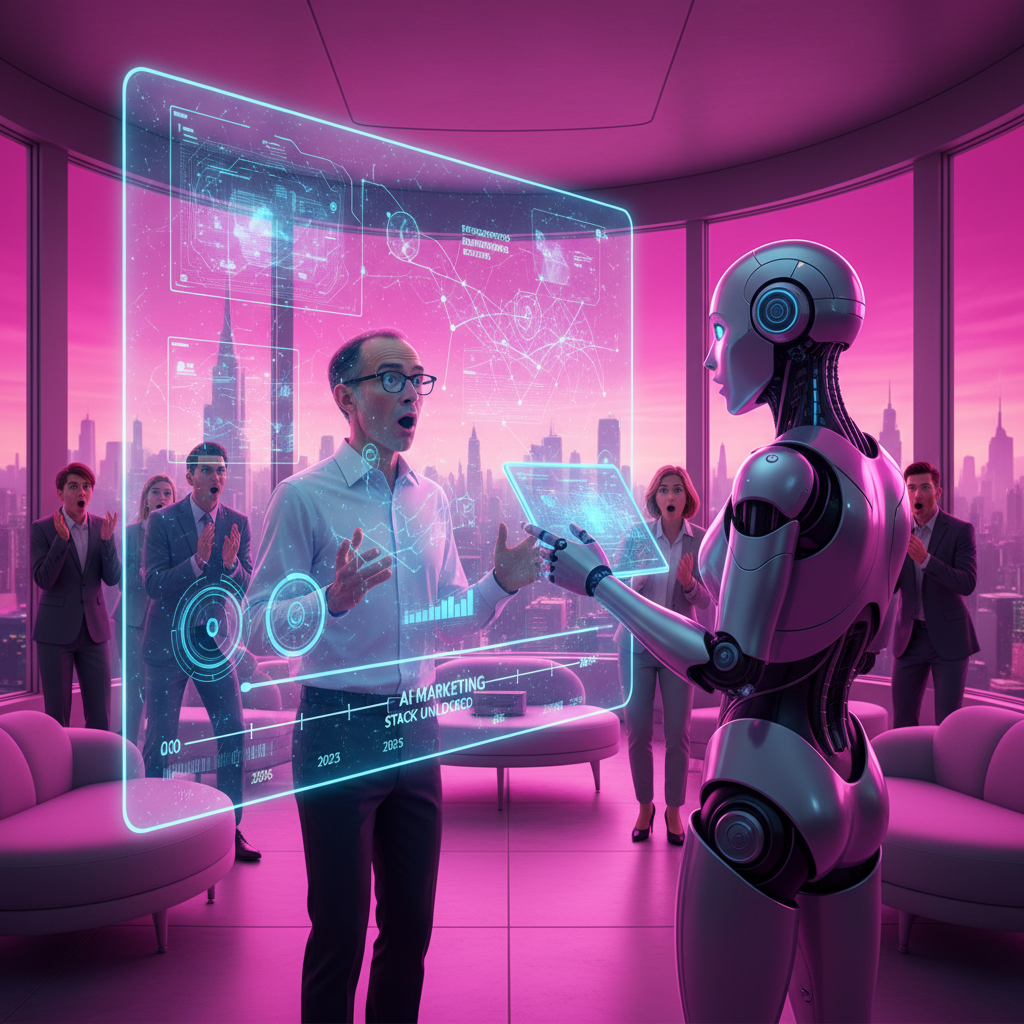
Unveiling the Agentic Marketing Stack – The Future of Business Growth
The digital world changes fast. If you want your business to grow, you must keep up. Today, relying on old, slow tools will leave you behind. You need a smarter, faster way to connect with customers. This is where the agentic marketing stack comes in.
What exactly is an agentic marketing stack? Think of it as a highly advanced, intelligent team of software. It is an AI-driven framework where smart, autonomous software agents work together. These agents collaborate with workflow tools and automation platforms. They execute complex marketing tasks with very little human help. They focus on goals you set for them.
This is much more than just using a few isolated artificial intelligence (AI) tools. It is a fully integrated ecosystem. It is built for goal-oriented autonomy and non-stop improvement.
We are seeing a massive paradigm shift in how businesses operate. The traditional marketing \”stack\” is dying. In the past, this stack was just a messy collection of separate tools. It required constant human effort and endless clicking. Now, it is transforming into a proactive, intelligent ecosystem. This change solves big problems. It handles the crazy complexity of modern customer journeys. It manages the massive explosion of data. It also answers the growing demand for deep, hyper-personalization at a massive scale.
Why does this matter right now? Businesses must adopt this evolution today. If you wait, you will miss out on unprecedented efficiency. You will miss out on deeper, clearer insights into your audience. Most importantly, you will fail to deliver the superior customer experiences that modern buyers demand. Adopting this stack is a strategic imperative for survival.
This shift gives us a clear glimpse into the future. We are rapidly moving toward the ai marketing stack 2026. This is not some distant, sci-fi dream. It is a present necessity. To stay ahead of your competitors, you must start building this future-ready system today.
In this blog post, you will take an educational journey. We will break down exactly what an agentic marketing stack entails. We will explore its core components and explain how it works. Finally, we will show you how your business can prepare for its implementation and dominate the future.
The numbers speak for themselves. The marketing world is changing rapidly. According to Statista, the market value of artificial intelligence in marketing is projected to reach over $107.5 billion by 2028. Businesses are racing to adopt these tools. View the Statista report on AI in marketing growth here.
Deconstructing the Agentic Marketing Stack: Core Components and Their Synergy
To understand the agentic marketing stack, we need to look under the hood. It is built on specific, powerful components. When these parts work together, they create amazing results. We also need to see how it uses modern ai automation marketing tools to get things done.
Beyond Simple Automation: The Essence of \”Agentic\”
First, we must understand the word \”agentic.\” This is very different from basic, old-school automation. Old automation just follows simple rules. It says, \”If this happens, then do that.\”
True \”agentic\” capabilities are much smarter. AI agents do not just follow a simple list of instructions. They are designed to perceive their digital environment. They learn from the massive amounts of data they process. They reason about what they see. They adapt their strategies on the fly. Most importantly, they take autonomous actions to achieve higher-level goals. For example, you might tell an agent to \”increase lead conversion by 10%.\” The agent figures out the best way to do it.
Autonomous AI Agents: Your Digital Workforce
Autonomous AI agents are the stars of the show. Think of them as intelligent software entities. They are often built as micro-services. They are designed to work entirely on their own or collaborate within the stack. They focus on specific tasks, but they learn, make decisions, and correct their own mistakes.
Here are some examples of AI agents working in marketing:
- Content Generation & Curation Agents: These agents analyze what content performs best. They find gaps in your strategy. Then, they write personalized marketing copy. They can draft blog outlines, social media posts, email subject lines, and ad variations. They always follow your brand guidelines and target specific audience segments.
- Data Analysis & Insight Agents: These agents never sleep. They constantly monitor your marketing campaigns across every channel. They identify hidden trends. They detect sudden problems, like a sharp drop in your click-through rate (CTR). They conduct root cause analysis to find out why it happened. Then, they proactively suggest data-driven fixes.
- Customer Interaction & Support Agents: These are powerful AI chatbots and virtual assistants. They go way beyond simple Frequently Asked Questions (FAQs). They handle initial customer chats. They qualify leads based on live interactions. They offer personalized product recommendations. If an issue is too complex, they smoothly hand it over to a human team member, providing all the background context.
- Campaign Optimization Agents: These agents manage your advertising money. They dynamically adjust bidding strategies in real-time. They re-target specific audience segments. They test different ad images and texts. They move your budget around to maximize your return on investment (ROI) or lower your cost per acquisition (CPA).
Workflow Orchestration & Integration Platforms
If AI agents are the workers, workflow orchestration platforms are the managers. These platforms serve as the central nervous system of the agentic marketing stack.
Their main job is to coordinate all the activities. They ensure various AI agents work together. They also connect these agents seamlessly with other ai automation marketing tools and older legacy systems you might still use.
These platforms allow agents to \”hand off\” tasks. For instance, a data analysis agent might spot a great sales opportunity. It then triggers a content generation agent to write a special email. Finally, it tells the CRM (Customer Relationship Management) system to update a customer record. This creates a smooth, end-to-end marketing workflow. This is often done using specialized Integration Platform as a Service (iPaaS) solutions.
Robust Data Foundation & Machine Learning Models
None of this works without a solid data foundation. The intelligence of AI agents depends completely on your data. Your data must be high-quality, easily accessible, and fully integrated.
You need a unified customer profile. You need data lakes or data warehouses to store everything. You also need real-time data ingestion so the agents have the latest information.
This all runs on underlying machine learning (ML) models. Machine learning gives agents their intelligence. It uses natural language processing (NLP) to understand text. It uses computer vision to understand images. It uses predictive analytics to guess what will happen next. This allows the agents to adapt and improve over time.
Real-world companies are already seeing massive success with these agents. For example, Klarna recently deployed an AI assistant that handles two-thirds of all customer service chats. It does the work of 700 full-time agents and vastly improves customer satisfaction. Read the Klarna AI case study here.
The Power Unleashed: AI Automation Marketing Tools in Action
Now let’s look at the specific tools. We need to see how practical ai automation marketing tools fit into the bigger picture. When integrated into an agentic marketing stack, these tools become incredibly powerful.
Strategic Automation vs. Basic Automation
We must remember the difference between strategic and basic automation. When these tools join an agentic marketing stack, they transcend simple rules. They are no longer just dumb software. They become intelligent, adaptive components. They are guided, supervised, and optimized by AI agents.
Key Categories of AI Automation Marketing Tools
Here are the major categories of these tools and how AI powers them:
- Customer Relationship Management (CRM) with AI: Tools like Salesforce Einstein, HubSpot’s AI features, or Microsoft Dynamics 365 are leading the way. They use AI for advanced lead scoring. They find hidden opportunities to upsell or cross-sell. They predict when a customer might leave (customer churn). They also give sales and marketing teams personalized \”next-best-action\” recommendations.
- Marketing Automation Platforms (MAPs) with AI: Platforms like Marketo Engage, Pardot, or ActiveCampaign are getting smarter. They use AI to dynamically group your audience into segments. They figure out the perfect time to send an email to each person. They personalize content delivery based on live user behavior. They build complex, adaptive customer journeys that change based on what the customer does.
- Content Intelligence & SEO Tools: Creating content is easier now. Tools like Clearscope, Surfer SEO, MarketMuse, Jasper AI, and Copy.ai use AI to analyze how content performs. They find semantic gaps in your writing. They suggest relevant topics you should cover. They optimize your writing for latent semantic indexing (LSI) keywords to help you rank higher on Google. They also generate diverse headlines and snippets, and they can detect plagiarism.
- Advertising & Media Buying Platforms with AI: Buying ads is now automated. Google Ads offers Performance Max. Meta Ads Manager offers Advantage+ campaigns. These programmatic advertising platforms use AI for automated bidding. They dynamically expand your audience to find new buyers. They generate personalized ad creative on the fly. They optimize your budget across multiple channels in real-time to get the highest Return on Ad Spend (ROAS).
- Customer Service & Support Automation: Helping customers is faster. AI-powered chatbots like Drift, Intercom bots, or Zendesk Answer Bot handle routine questions instantly. They provide immediate, contextual support. They qualify leads quickly. They also connect deeply with your CRM to give human agents a unified view of the customer when they take over the chat.
- Analytics & Reporting Tools with AI: Understanding numbers is simpler. Platforms like Google Analytics 4 offer predictive capabilities for churn and purchase intent. Specialized AI analytics dashboards and tools like Tableau use AI to automatically find insights. They predict future trends. They recommend actionable strategies without requiring you to do hours of manual math.
Synergy within the Stack: A Practical Example
Imagine this scenario. An AI agent from your stack spots a specific customer segment showing high intent to buy. Instantly, this triggers an ai automation marketing tool (like a smart ad platform) to serve highly personalized ads to those exact people. At the exact same time, another AI agent uses a content generation tool to write a custom landing page just for that segment. The integration platform orchestrates all of this seamlessly in the background.
The Massive Benefits of Integration
Integrating these advanced ai automation marketing tools into an agentic marketing stack creates magic. It builds a cohesive, powerful, and intelligent system. This connected system easily surpasses a bunch of individual, disconnected parts. It leads to exponential gains in your marketing performance.
These tools are changing the landscape of business software. Reports from top software review sites show that AI features are now the biggest driver of CRM and marketing automation adoption, significantly boosting ROI. Explore top marketing automation tools and their AI impact on G2.
The Future is Now: Preparing for the AI Marketing Stack 2026
The marketing world does not stand still. The agentic marketing stack is a continuously evolving framework. It is not a final destination. We must prepare for the ai marketing stack 2026. This future stack will be even more sophisticated. It will be more interconnected and vastly more autonomous. It will be driven by incredible advancements in AI research and new practical applications. To win, you must combine this vision with your current ai automation marketing tools.
Key Trends & Predictions for the AI Marketing Stack 2026
What does the near future hold? Here are the major trends to watch:
- Hyper-Personalization at Scale & Proactive Marketing: Marketing stacks will soon deliver real-time, highly individualized experiences across every single touchpoint. The precision will be mind-blowing. AI will stop just reacting to past behavior. Instead, it will predict customer needs, market shifts, and the perfect engagement points long before they actually happen.
- Enhanced Human-AI Collaboration (Centaur Marketing): AI is not here to steal your job. The focus is on AI augmenting human capabilities. Marketers will evolve into strategic supervisors. They will become data interpreters and creative directors of their agentic stacks. Humans will focus on high-level strategy and ethical oversight. The AI will handle all the heavy execution.
- Ethical AI, Transparency, and Explainability: With great power comes great responsibility. Regulatory scrutiny is increasing. Consumers demand privacy. There will be a massive emphasis on responsible AI use and robust data privacy frameworks. We will also need explainable AI (XAI). This means the AI must be able to explain exactly why it made a certain decision. This builds trust and ensures legal compliance.
- Voice, Conversational AI, and Multimodal Experiences: The way we interact with machines is changing. We will see deeper integration of advanced natural language processing (NLP) and natural language generation (NLG). Voice assistants and multimodal AI (which handles text, image, and voice at once) will create natural, intuitive interactions. This will happen across new channels, including smart devices and the metaverse.
- Composable Marketing Architecture: Rigid software is dead. Businesses will favor flexible, modular, API-first ai automation marketing tools. These tools can be easily plugged into your agentic marketing stack. They can be orchestrated smoothly, allowing for maximum agility and endless customization.
- Autonomous Campaign Management: AI agents will become incredibly capable. They will handle end-to-end campaign creation, deployment, and optimization. Once you set the strategic goals, the AI will require almost zero human intervention to run the campaign.
Strategic Planning for Businesses: Actionable Advice
How do you get ready for this? Follow these actionable steps:
- Audit Your Current Stack & Data Infrastructure: Take a hard look at your current setup. Conduct a thorough assessment of your existing marketing technologies. Review your data sources and integration capabilities. Find the gaps and pinpoint the best opportunities to infuse AI.
- Identify High-Impact Use Cases: Don’t try to fix everything at once. Determine where AI agents and automation can deliver the biggest, fastest business value. Look at your current workflows. Great starting points are often lead qualification, content optimization, or customer support.
- Invest in Data Governance, Hygiene, and Integration: Data is the fuel for AI. Stress the critical importance of high-quality, unified, and accessible data. Prioritize building robust, clean data pipelines. If your data is bad, your AI will be bad.
- Upskill Your Marketing Team: Your people need new skills. Highlight the need for AI literacy. Teach them data interpretation and prompt engineering. Educate them on ethical AI considerations. Train them to become strategic supervisors of autonomous systems.
- Start Small, Experiment, and Scale Smart: Advise a phased approach. Begin with small pilot projects in specific, controlled areas. Measure the ROI carefully. Learn from the results. Then, gradually scale the successful implementations across your entire organization.
Leading research firms agree on this timeline. Gartner predicts that by 2026, over 30% of workers will leverage AI agents to automate their daily tasks, a massive jump from today. Explore Gartner’s Top Strategic Technology Trends predicting AI agent adoption.
Benefits of Implementing an Agentic Marketing Stack
Why should you go through the effort of building this? Because the rewards are massive. Adopting an agentic marketing stack filled with smart ai automation marketing tools brings tangible, strategic advantages. It completely transforms how your business grows.
Exponential Increase in Efficiency & Productivity
The speed upgrade is unbelievable. You can automate boring, repetitive, time-consuming tasks. Think about weekly reporting, writing initial content drafts, or making tiny daily campaign adjustments. AI agents handle all of this. This frees your human marketers to focus on what humans do best: high-level strategy, deep creativity, and building real customer relationships. You will achieve faster execution of campaigns and lightning-fast, data-driven responses to competitor actions.
Enhanced Personalization & Superior Customer Experience
Customers want to feel special. You can leverage AI agents and ai automation marketing tools to deliver highly relevant, individualized content. You can send the perfect offers and create flawless interactions across every touchpoint. The system caters to each customer’s unique journey and preferences in real-time. This dramatically improves customer satisfaction, builds intense loyalty, and creates brand advocates.
Deeper Data Analysis & Actionable Insights
Humans cannot read millions of spreadsheets in a minute. AI agents can process, analyze, and synthesize vast mountains of marketing and customer data instantly. They work at speeds and scales impossible for human teams. They uncover hidden patterns, secret correlations, and incredibly valuable predictive insights. This enables truly data-driven decision-making. You move away from reactive, backward-looking reporting. You move toward proactive, predictive strategies that anticipate what your customers want next.
Optimized Return on Investment (ROI) & Cost Savings
This stack protects your wallet. You get hyper-precise campaign targeting. The AI handles dynamic budget allocation, moving pennies to where they work best. The continuous optimization driven by AI agents drastically reduces wasted ad spend. It massively improves the effectiveness of your marketing investments. Furthermore, automating workflows leads to massive operational cost savings over time. You reduce manual effort and eliminate expensive human errors.
Unmatched Scalability & Agility
Growing your business becomes easier. You can easily scale your marketing efforts to meet huge spikes in demand. You can expand into entirely new international markets. And you can do this without needing to hire an army of new employees. The AI agents easily handle the increased workload. The stack’s intelligent, adaptive nature also allows you to pivot rapidly. You can adapt to new market trends, sudden regulatory changes, or unforeseen global challenges in a flash.
Significant Competitive Advantage
This is the ultimate bottom line. Businesses that strategically implement and evolve their agentic marketing stack will win. You will gain a massive, decisive edge over competitors who are still stuck relying on older, slower, and less intelligent marketing methods. Adopting this technology paves the direct path to industry market leadership.
The financial impact of AI is staggering. A report by McKinsey & Company highlights that generative AI and automated systems could add up to $4.4 trillion to the global economy annually, with marketing and sales being the biggest beneficiaries. Read the McKinsey report on the economic potential of AI here.
Conclusion: Embracing the Agentic Future of Marketing
We have covered a lot of ground. Let’s recap the core concept. The agentic marketing stack is an intelligent, autonomous, and fully integrated system. It is powered by brilliant AI agents and advanced ai automation marketing tools. It has the absolute power to transform modern businesses from the ground up.
We must reiterate a crucial point: this is not a luxury. Adopting and evolving towards an agentic marketing stack is an essential strategic imperative. If you want your business to thrive in a complex, fiercely competitive digital landscape, you have no other choice.
As we look ahead to the ai marketing stack 2026, remember that the journey never stops. Continuous learning is required. Strategic planning and adaptive implementation are your best friends. They are crucial for navigating this evolving landscape and capitalizing on future advancements in robotic process automation and AI. Forward-thinking is the key to your survival and success.
Do not wait for the future to happen to you. Begin your journey today. Explore the incredible ai automation marketing tools available right now. Assess your current data infrastructure. Start upskilling your team immediately. Run your first AI-driven pilot projects.
Exciting possibilities, unprecedented growth, and an unbreakable competitive advantage are waiting for you. All you have to do is embrace this intelligent marketing revolution.
Ready to build a world-class, AI-driven marketing engine for your business? Stop guessing and start growing. Contact the experts at BoosterDigital today. Let our team help you design, implement, and master your own agentic marketing stack to dominate your industry.