
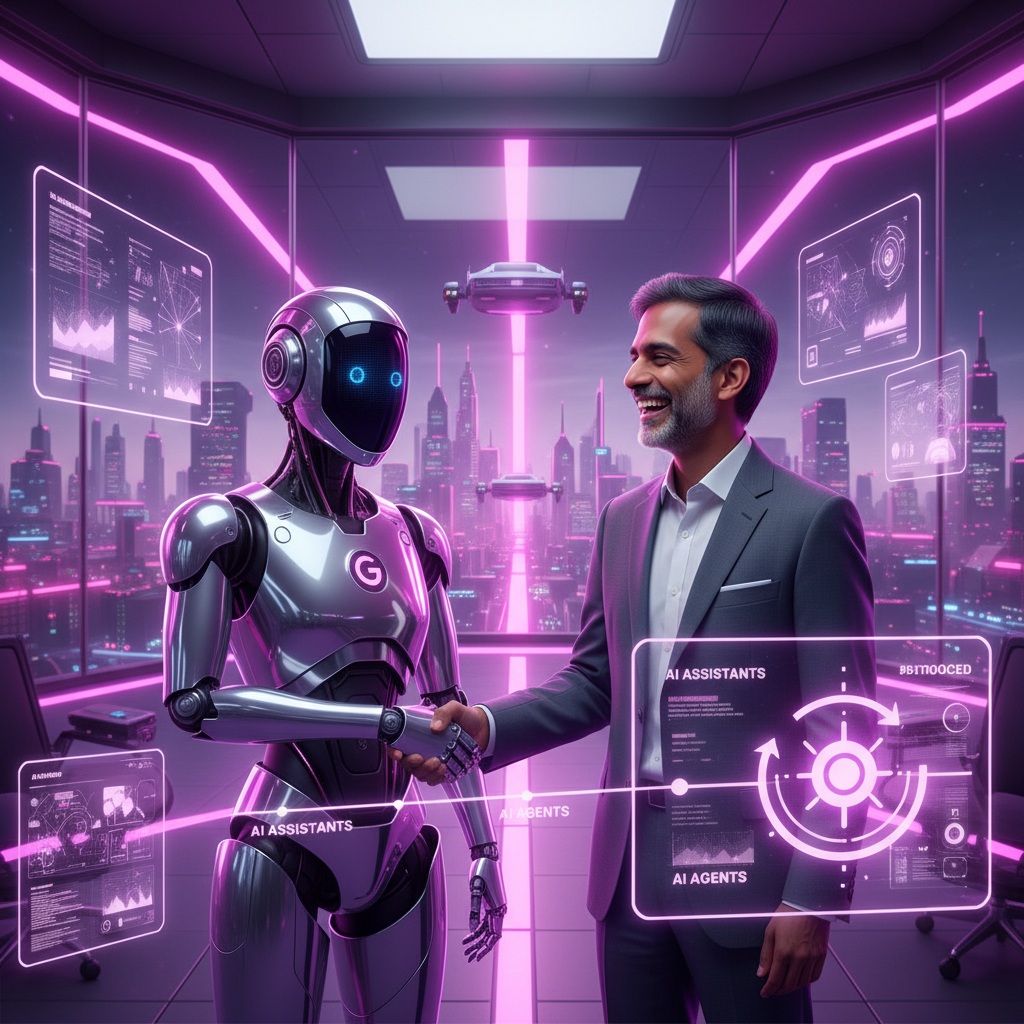
The Apex of Automation: Tracing the Evolution of AI Automation to Truly Autonomous AI Systems
We live in a world where technology moves at a lightning-fast pace. Everywhere we look, from the smartphones in our pockets to the software running large global businesses, Artificial Intelligence (AI) is making a massive impact. It is changing how we work, how we play, and how we solve everyday problems. But AI is not just a single, unchanging tool. It is constantly growing, learning, and improving. At the very center of this rapid growth is the fascinating journey of intelligent machines, leading us straight to the incredible world of autonomous AI systems.
When we talk about autonomous AI systems, we are talking about the absolute cutting edge of artificial intelligence. These are not just computer programs that follow basic commands. They are highly advanced systems capable of thinking, planning, and acting on their own to achieve major goals. The purpose of this guide is to comprehensively explore the complete evolution of ai automation. We will look closely at how basic, simple computer programs have slowly transformed over time into these self-governing, intelligent entities that are shaping our future.
To truly understand how far we have come, we need to look at the roadmap of this amazing journey. We will break down this evolutionary timeline step by step. First, we will look at the early days of rudimentary chatbots. Next, we will explore the rise of helpful, voice-activated AI assistants. From there, we will dive into the proactive world of AI agents. Finally, we will reach the peak of this technological mountain: the highly advanced concept of autonomous systems.
This rapid progression is not happening by accident. It is being fueled by massive amounts of data, faster computers, and huge investments from tech companies all over the world. According to the recent Global AI Market Trends and Future Projections Report 2024, the immense global investment and rapid innovation driving AI are setting the stage for even more unbelievable breakthroughs in smart automation.
The Genesis: Rule-Based Chatbots in the Evolution of AI Automation
If we want to map out the evolution of ai automation, we have to start at the very beginning. The genesis of automated digital conversation began with something we are all very familiar with today: rule-based chatbots. These bots represent the foundational and most basic form of interaction between humans and artificial intelligence.
So, what exactly is a rule-based chatbot? Think of it as a very strict, digital filing cabinet. It is an elementary computer program designed to simulate a human conversation through a text or voice interface. However, it does not actually \”think.\” Instead, it operates on a rigid set of rules, specific keywords, and pre-defined scripts created by human programmers. If you type a specific word, the chatbot will spit out a specific, pre-written answer.
While they were a great first step, these early chatbots had severe limitations. Here is a breakdown of how they functioned and where they fell short:
- Pre-programmed Responses: They only know what they have been explicitly told. They operate entirely on \”if-then\” logic. For example, \”IF the user types ‘refund’, THEN show the refund policy text.\”
- Limited Understanding: These bots lack any true contextual understanding. They do not possess emotional intelligence. If you phrase a question slightly differently than what they are programmed to recognize, they get confused. They cannot deviate from their programmed flow, which often leads to the dreaded \”I’m sorry, I don’t understand\” message.
- Specific Tasks: They are built for very narrow, specific interactions. You usually find them answering Frequently Asked Questions (FAQs), helping users reset a password, or providing simple, tier-one customer service support.
Good examples of these systems are the early customer service chat bubbles you used to see on store websites, or the simple phone tree navigators that ask you to \”Press 1 for Sales, or Press 2 for Support.\” Even though they were limited, we must view chatbots as the crucial, experimental first step in the evolution of ai automation. They proved that automated communication was possible and set the stage for the smarter technology that was about to come.
Stepping Up: The Rise of AI Assistants
As technology improved, programmers realized that simple \”if-then\” chatbots were not enough. People wanted to interact with computers in a more natural way. This desire led to a massive upgrade and a significant step forward in the evolution of ai automation: the creation of AI assistants.
AI assistants are vastly more sophisticated than basic chatbots. Instead of just looking for specific keywords, they use advanced technologies called Natural Language Processing (NLP) and Machine Learning algorithms. NLP acts like a digital translator. It helps the computer actually understand the intent and context behind human words, even if we use slang or phrase things differently.
Because they can understand us better, AI assistants have enhanced functionality that makes our daily lives much easier:
- Natural Language Understanding: They process and interpret human language highly effectively. You can say, \”Do I need an umbrella today?\” and the assistant knows you are actually asking for the weather forecast.
- Broader Task Execution: They can handle a wide array of discrete commands. You can tell them to set your morning alarms, play a specific music playlist, send a text message to your mom, or perform quick math calculations and web searches.
- Personalization: Over time, they offer a degree of personalization. They remember your past interactions, your location, and your preferences to give you better, more tailored answers.
Examples of these helpful tools are everywhere today. Apple’s Siri, Amazon’s Alexa, and Google Assistant live inside our phones, our smart speakers, and even our cars. However, to truly understand the ongoing debate of ai assistants vs agents, we must look at one critical limitation: their reactive nature.
AI assistants are incredibly smart, but they are completely reactive. They sit quietly and wait for you to give them a direct command. They do not initiate actions on their own, and they do not pursue complex, multi-step goals independently. You have to guide them every single step of the way. Still, their integration into our lives is undeniable. As noted in the study The Ubiquitous Presence of Voice Assistants in Modern Households, the growing market penetration and user reliance on virtual assistants in everyday life prove how vital this reactive stage has been.
A Major Leap: Understanding AI Agents and Agentic AI Explained
We are now reaching a thrilling and highly advanced stage in the evolution of ai automation. To move beyond systems that just wait around for human commands, developers created AI agents. This marks a pivotal advancement, shifting the focus from simple reactive assistance to powerful, proactive problem-solving.
What exactly is an AI agent? An AI agent is a goal-oriented, proactive software system. Unlike an assistant that just does one single task when told, an agent is designed to achieve complex objectives. It does this by taking a large goal, breaking it down into smaller, manageable sub-tasks, planning a logical sequence of actions, executing those actions, and monitoring its own progress until the final goal is met.
To get a clear picture of how this works, we need to have agentic ai explained through its core concepts:
- Proactivity: This is the biggest game-changer. Agents do not need continuous human prompting. Once you give them a goal, they initiate the necessary actions to pursue it entirely on their own.
- Planning and Reasoning: They possess a form of artificial logic. They can strategize multi-step actions, deduce logical conclusions from data, and make informed decisions to overcome obstacles they might face along the way.
- Memory and Context Retention: Agents maintain a persistent internal state. They remember what worked and what failed in the past. This short-term and long-term memory allows them to adapt their behavior and improve over time.
- Tool Use and Integration: This is a massive leap in capability. AI agents are often equipped to utilize external digital tools. They can independently open a web browser to search for information, use coding interpreters to write and test software, or interact with databases and other APIs.
- Decomposition of Goals: They can take a massive, high-level goal (like \”research competitors\”) and chop it down into smaller, executable steps (like \”find top 5 companies,\” \”read their websites,\” \”summarize their pricing\”).
Now, let us clearly address the crucial difference when looking at ai assistants vs agents. Imagine you need to travel for work. If you use an AI assistant, you have to say, \”Book a flight to London.\” Then, you have to say, \”Find hotels in London.\” Then, you have to say, \”Book a rental car.\” The assistant only does exactly what you command, one step at a time.
An AI agent, on the other hand, operates entirely differently. You would simply give the agent a high-level directive: \”Plan a three-day business trip to London for next week under a $2000 budget.\” The agent would then proactively check your calendar, search for flights, compare hotel prices, book the travel, arrange ground transportation, and schedule your meetings, all without you having to guide it through each individual step. This incredible capability is discussed deeply in the research paper Architectural Paradigms for Intelligent Agents: A Survey, which details the architectural principles and emerging capabilities that make these proactive agents possible.
The Frontier: Truly Autonomous AI Systems
We have finally arrived at the pinnacle of artificial intelligence capabilities. At the very top of the evolution of ai automation ladder sit truly autonomous AI systems. These represent the ultimate goal of computer science and digital engineering.
How do we define autonomous AI systems? These are the next generation of intelligent machines. They take all the proactive, planning, and reasoning skills of AI agents and push them to the absolute limit. They extend these capabilities to operate with massive independence. They feature advanced self-correction, continuous deep learning, and the ability to adapt to complex, dynamic, and highly unpredictable real-world environments. Most importantly, they do all of this with minimal to absolutely zero human oversight for long periods of time.
To truly grasp how powerful these systems are, we have to look at their advanced capabilities:
- Self-Correction and Error Recovery: Standard computer programs crash when they make an error. Autonomous systems have the ability to detect errors or inefficiencies in their own operations. They can then dynamically adjust their strategies or rewrite their processes to fix the problem without a human engineer ever having to type a line of code.
- Continuous Learning and Adaptation: They never stop getting smarter. They constantly absorb new data and experiences. Through processes like reinforcement learning, they adjust to environmental changes, continuously improving their performance and decision-making skills over months and years.
- Operating in Dynamic Environments: Life is messy and unpredictable. Autonomous systems are uniquely designed to thrive and make real-time decisions in uncertain, constantly changing, open-ended conditions where the rules are not always clear.
- Long-Term Goal Pursuit: While an agent might plan a trip, an autonomous system can pursue strategic, long-term objectives that span years. This involves juggling thousands of sub-goals and making continuous adaptations based on shifting global data.
- Unmatched Resilience: They possess robust internal mechanisms that allow them to maintain functionality and keep pushing forward even when facing unexpected challenges, broken data streams, or partial system hardware failures.
These are not just science fiction concepts; they are actively being built into real-world applications that will define our future vision:
- Level 5 Self-Driving Vehicles: Imagine cars and trucks that can operate completely without human intervention, navigating through heavy rain, sudden traffic jams, and complex city streets flawlessly.
- Adaptive Robotics in Smart Factories: Modern manufacturing relies on robots that do not just follow a repetitive script. These autonomous machines can reconfigure their own tasks, talk to other robots, and collaborate autonomously to optimize production lines in real-time if a part goes missing.
- Intelligent Energy Grids: Massive power systems that can manage the distribution, generation, and consumption of electricity autonomously, preventing blackouts and maximizing energy efficiency across entire cities.
- Autonomous Scientific Discovery Platforms: Imagine an AI that acts as a lead scientist. It can formulate chemical hypotheses, design laboratory experiments, control robotic arms to execute the tests, analyze the complex results, and iterate on new hypotheses all on its own to discover new medicines.
It is clear that autonomous AI systems represent the most breathtaking stage in the evolution of technology. AI is officially moving from being a simple tool that we use, to a truly independent and self-sufficient intelligent partner. Of course, building machines with a mind of their own brings up massive questions. As highlighted in the critical resource Navigating the Ethical Landscape of Autonomous AI, the ethical considerations, strict safety protocols, and complex regulatory challenges are absolutely paramount in the safe development and deployment of these independent systems.
The Holistic View: Tracing the Evolution of AI Automation
To truly appreciate the power of modern technology, it is incredibly helpful to look at the holistic view of the evolution of ai automation. By looking back, we can see exactly how the building blocks of code became the foundation for thinking machines. Let us provide a clear, concise recap of these four distinct, world-changing stages:
- Stage 1: Chatbots. These were strictly reactive and rule-based. They possessed minimal intelligence and relied entirely on scripted, if-then logic to answer basic user questions.
- Stage 2: AI Assistants. A major step up. Still reactive, but powered by NLP. They became highly task-specific and featured greatly enhanced language understanding. This is where we first see the baseline for the ai assistants vs agents comparison.
- Stage 3: AI Agents. The shift to proactivity. Agents are goal-driven. As we explored when having agentic ai explained, these systems use planning, logic, reasoning, and tool-use to complete complex, multi-step objectives on their own.
- Stage 4: Autonomous AI Systems. The ultimate frontier. These are self-correcting, highly adaptive machines that continuously learn. They boast independent operation in chaotic, dynamic environments without human supervision.
What are the driving forces behind this rapid evolution of ai automation? It comes down to a perfect storm of technological advancements. First, we have seen massive leaps in raw computational power; our computer chips are faster and more capable than ever before. Second, the internet has provided us with access to vast, unimaginable datasets—oceans of information that AI uses to learn. Finally, engineers have developed highly sophisticated algorithms, like deep neural networks and machine learning protocols, alongside vastly improved physical sensor technologies for robots and cars.
As we moved from chatbots up to autonomous ai systems, the value provided to humanity has increased exponentially. Each progressive stage has unlocked greater levels of business efficiency, allowed us to handle mind-boggling complexity, and generated transformative value across healthcare, finance, logistics, and education sectors.
Challenges, Opportunities, and the Path Ahead
Standing on the edge of this new technological frontier brings a mix of excitement and caution. The widespread adoption of autonomous AI systems presents the world with both immense opportunities and significant, complex challenges that we must navigate carefully.
Let us look at the bright side first. The immense opportunities are truly world-changing:
- Revolutionizing Industries: Autonomous technology is streamlining global supply chain operations, vastly enhancing worker productivity, and creating entirely new business models that we could not have imagined a decade ago.
- Solving Grand Challenges: These brilliant systems have the computing power to address complex global issues. They can process climate data to fight global warming, analyze DNA to cure diseases, and optimize global agriculture to fight hunger.
- Enhancing Human Capabilities: By taking over tedious, repetitive data entry or highly dangerous physical tasks (like deep-sea welding or bomb disposal), autonomous machines are freeing up human potential. This allows people to focus on creativity, strategy, and empathy-driven work.
However, we cannot ignore the significant challenges and risks that come with building autonomous AI systems:
- Ethical Implications: There are massive concerns around accountability. If an autonomous self-driving car gets into an accident, who is at fault? Furthermore, we must actively fight against hidden biases in AI decision-making to ensure fairness. There is also the very real economic concern of job displacement as machines become capable of doing human work.
- Safety and Reliability: We must ensure robust, guaranteed performance. Preventing unintended consequences is critical, especially when AI is used in life-or-death applications like healthcare diagnostics or national defense grids.
- Regulatory Frameworks: Technology moves faster than government. There is an urgent, pressing need for clear, adaptive laws and international standards to properly govern the development and global deployment of these incredibly powerful systems.
- Transparency and Explainability: This is known as the \”black box\” problem. Sometimes, an autonomous AI system is so complex that even its creators do not fully understand exactly *why* it made a specific decision. We need systems that can clearly explain their logic to humans.
- Human-AI Collaboration: We are entering an era where we must clearly define the evolving roles, boundaries, and daily interactions between human workers and increasingly independent machines.
Because these challenges affect the entire globe, international cooperation is essential. High-level groups are already working on this, as seen in the important initiative, the OECD Principles on AI and Governance of Autonomous Systems, which focuses on developing fair policies for advanced AI governance.
Conclusion: A New Era of Intelligence and Automation
We have taken an incredible, eye-opening journey through the complete evolution of ai automation. We started by looking at the basic, reactive nature of simple chatbots. We then explored the helpful but limited scope of voice software, clearly outlining the differences in the ai assistants vs agents debate. We broke down the proactive, goal-seeking nature of software by having agentic ai explained clearly. Finally, we saw how all of these stepping stones have led us to the most powerful technology of our lifetime: truly independent autonomous AI systems.
Understanding this highly nuanced progression is not just an academic exercise for computer scientists. It is absolutely crucial for business leaders, everyday stakeholders, government policymakers, and the general public. We all must understand the trajectory of this technology to properly navigate the transformative power of artificial intelligence in our daily lives.
The future is bright. We must maintain an optimistic yet highly responsible outlook. By advocating for continued, bold innovation that is tightly paired with thoughtful, strict ethical considerations, we can harness the full, beneficial potential of smart automation. We are officially moving into a new era defined by intelligence, speed, and autonomous AI systems.
Are you ready to bring the power of advanced smart automation and digital marketing into your business? Do not let the future leave you behind. Transform your company’s efficiency and drive massive growth by partnering with experts who understand the cutting edge of digital technology. Contact BoosterDigital today and let us build the intelligent automated solutions your business needs to thrive in the modern era.