
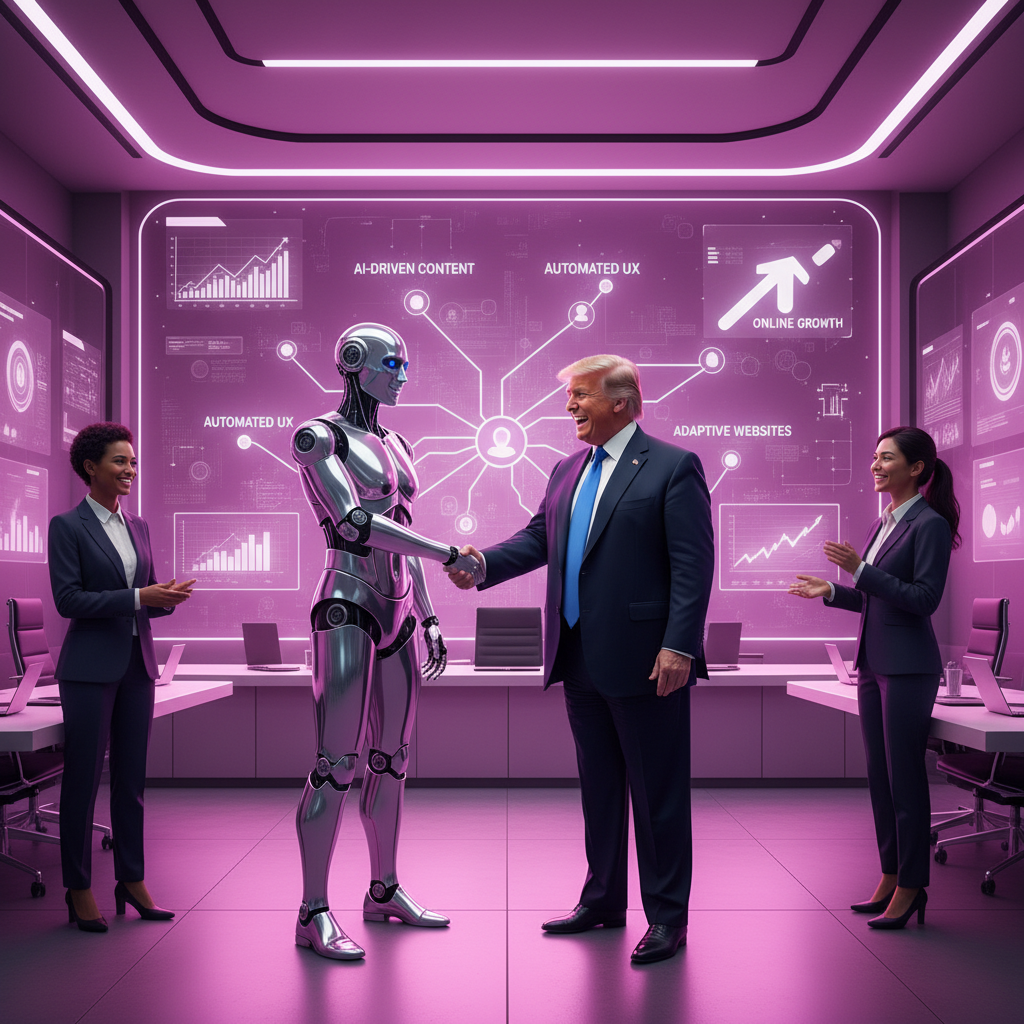
Unlocking Growth: How AI Website Personalization Delivers Dynamic Digital Experiences
In today’s crowded and competitive digital landscape, a generic online presence is no longer enough. Websites that treat every visitor exactly the same struggle to capture attention, let alone retain it. Users now expect more than one-size-fits-all content; they demand relevance, speed, and understanding. When a visitor lands on your page, they want to feel like the experience was crafted just for them.
This is where ai website personalization becomes the ultimate differentiator. It acts as the crucial strategy for forward-thinking businesses aiming to stand out and deliver truly relevant interactions. By leveraging the power of artificial intelligence, companies can move beyond static pages to create living, breathing digital ecosystems that respond to user needs in the moment.
But what exactly is this technology? AI website personalization is the use of artificial intelligence to dynamically tailor content, product recommendations, and overall user experiences in real-time. It works by analyzing vast amounts of visitor behavior, demographics, and historical data to serve the most relevant information without the need for manual rules. According to industry experts, this approach boosts engagement and conversions significantly by removing the guesswork from marketing (Source).
The shift here is fundamental. We are moving away from traditional, rules-based personalization—where a marketer might manually set a rule like \”if visitor is from New York, show winter coats\”—to AI-driven adaptation. AI models process data instantly, recognizing patterns no human could see, and adjusting the website experience milliseconds before the page even finishes loading. The purpose of this guide is to explore exactly how AI transforms standard websites into highly engaging, user-centric platforms that drive growth.
Why AI Website Personalization is a Game-Changer: The Core Benefits
Adopting ai website personalization is not just about using a buzzword; it is a strategic move that directly impacts the bottom line. The benefits of transitioning to an intelligent, data-driven website are measurable and substantial.
Enhanced Engagement
One of the primary advantages is the dramatic improvement in user engagement. When a website intuitively presents content that matches a user’s interests, they are far more likely to stay on the site longer. Personalized experiences reduce bounce rates because the visitor immediately sees value. Whether it is a blog post related to a previous read or a product that complements a past purchase, relevance encourages deeper interaction and exploration.
Increased Conversion Rates
The correlation between personalization and sales is undeniable. Companies implementing AI-driven strategies report significantly higher success in turning visitors into customers. In fact, businesses using these advanced tactics have seen up to 42% higher conversion rates. This is achieved by adapting content elements—such as product suggestions, banners, or special offers—instantly based on user actions like clicks, scroll depth, or specific navigation paths (Source).
Boosted Revenue
Higher conversion rates naturally lead to better financial outcomes. Fast-growth businesses are realizing that personalization is a key revenue driver. Research indicates that these agile companies derive 40% more revenue from personalization efforts compared to their slower-moving counterparts. By presenting the right offer to the right person at the exact right time, AI maximizes the value of every website visit (Source).
Improved Customer Loyalty
Acquiring a new customer is often more expensive than retaining an existing one. AI website personalization builds a bridge of trust between the brand and the consumer. By consistently delivering relevant content and anticipating needs, businesses foster a sense of being \”understood.\” This strengthens the relationship, leading to higher customer lifetime value and frequent repeat visits.
Operational Efficiency
Finally, AI serves as a powerful multiplier for your marketing team. Traditional personalization requires setting up endless manual rules and segments, which is time-consuming and prone to error. AI automates these complex tasks, freeing up your team to focus on high-level strategy and creative campaigns rather than getting bogged down in the mechanics of segmentation and content delivery.
The Mechanics of Personalization: How AI Dynamic Website Content Works
To truly understand the power of this technology, we must look at the engine room: ai dynamic website content. This refers to the specific elements on a webpage that change in real-time based on individual user data and behavior. It is the tactical execution of the broader ai website personalization strategy.
Real-time Behavioral Targeting
The core mechanism involves analyzing in-session data. As a user navigates your site, AI algorithms are tracking metrics such as time spent on a specific page, category browsing history, and clickstream data. This information is processed instantly to update website elements.
- Retail: Instead of a generic homepage, a returning visitor might see a banner for \”Running Shoes\” because they spent five minutes looking at sneakers during their last session. The AI matches product interests with real-time recommendations to drive the sale.
- Travel: A travel agency site can display location-specific deals. If a user is browsing flights to tropical destinations, the ai dynamic website content engine might swap out a \”Ski Trip\” hero image for a \”Caribbean Resort\” package.
- Media: News outlets use this to keep readers hooked. By analyzing reading history, the site can suggest trending content or articles that align with the user’s specific political or cultural interests (Source).
Predictive Personalization
While behavioral targeting reacts to what is happening now, predictive personalization looks to the future. Machine learning models use historical data to anticipate what a user will likely want next. This predictive capability allows the system to determine the optimal combination of headlines, images, and offers to show a specific user.
Crucially, this process is significantly faster than traditional methods. While human-led A/B testing can take weeks to reach statistical significance, predictive AI can accelerate these learnings, identifying the winning content variations in a matter of hours and adjusting automatically (Source; Source).
Generative AI for Content
The newest frontier in ai dynamic website content is Generative AI. This technology doesn’t just select pre-made content; it can create it. AI can generate or swap elements like headlines, email subject lines, or short descriptions on the fly. By using historical data, Generative AI ensures that the tone and message are consistent across different channels, creating a seamless narrative for the user (Source; Source).
Beyond Content: AI User Experience Automation for Seamless Journeys
Personalization is not limited to text and images. AI user experience automation applies intelligence to the functional aspects of a website, streamlining the user’s journey from entry to exit. This ensures that the structure of the site itself supports the goals of ai website personalization.
Optimized Navigation
Static menus can be overwhelming. AI user experience automation can dynamically adjust website menus and internal links based on user intent. If a user consistently visits the \”Enterprise Solutions\” section, the site can automatically prioritize those links in the navigation bar, making it easier for them to find what they need without digging through irrelevant options.
Personalized Forms and Workflows
Friction is the enemy of conversion. AI helps remove obstacles by pre-filling forms with known data or guiding users through complex processes. For example, if a user is applying for a quote, the system can offer context-sensitive help or skip steps that are not relevant to their specific industry. This reduces frustration and drastically improves form completion rates.
Intelligent Chatbots and Virtual Assistants
Modern chatbots are a prime example of ai user experience automation. Unlike old script-based bots, AI-powered virtual assistants understand natural language and context. They provide instant, personalized support. If a user is stuck on a checkout page, the bot can pop up and ask, \”Do you have questions about shipping to [User’s City]?\” This proactive guidance solves problems before the user abandons the site.
Proactive Engagement
Timing is everything. AI monitors user behavior for signals like \”exit intent\” (moving the mouse towards the close button) or prolonged inactivity on a product page. It can then trigger personalized pop-ups, notifications, or special discount offers at that exact moment to re-engage the visitor. By automating these touchpoints, the website becomes a proactive sales agent rather than a passive brochure.
Building the Future: The Concept of AI Adaptive Websites
When you combine dynamic content with UX automation, you arrive at the concept of ai adaptive websites. These are the pinnacle of ai website personalization. An adaptive website is not just a collection of pages; it is a system that continuously learns, evolves, and optimizes itself based on visitor behavior.
Continuous Learning and Optimization
Unlike static sites that sit unchanged until a developer updates them, ai adaptive websites are always working. They constantly analyze performance metrics, implicit user feedback (like dwell time), and explicit feedback (like ratings). Using this data, they make real-time adjustments to layouts, content presentation, and functional elements to better suit the audience.
Self-Improving Ecosystems
Think of an adaptive website as a living entity. It iterates on personalization strategies automatically. If it detects that a certain segment of users responds better to video content than text, it will automatically prioritize video for that group. It identifies what works best for different demographics and refines its approach without waiting for human instructions.
Reduced Manual Intervention
One of the most significant benefits of ai adaptive websites is the reduction in manual workload. Marketers no longer need to constantly monitor dashboards and manually tweak A/B tests. The website itself is intelligent enough to optimize its own performance. This allows businesses to maintain a cutting-edge, high-performing online presence with significantly less manual maintenance.
Choosing Your Arsenal: Key AI Personalization Tools and Platforms
To achieve this level of sophistication, businesses need the right technology. The landscape of ai personalization tools is vast, but understanding the categories and key players is essential for success.
Categories of Tools
- Customer Data Platforms (CDPs): These are the foundation of ai website personalization. CDPs unify customer data from various sources (social media, email, website) to create a single, comprehensive view of each customer.
- AI-powered CMS: Some Content Management Systems now come with integrated AI capabilities, allowing for dynamic content generation and optimization directly within the editing environment.
- Dedicated Personalization Platforms: These are specialized tools designed specifically for real-time personalization. They often feature advanced recommendation engines, behavioral analytics, and A/B testing suites.
Key Features to Look For
When selecting ai personalization tools, prioritize the following capabilities:
- Real-time behavioral analytics: The ability to process data instantly.
- A/B and multivariate testing: Automated testing to find the best variations.
- Recommendation engines: Algorithms that suggest products or content (e.g., \”Customers who viewed this also viewed…\”).
- Integration: Seamless connection with your existing CRM, email marketing, and analytics stack.
- Visual editors: Easy-to-use interfaces for marketing teams to create personalized experiences without coding.
Examples of Leading Tools
- SAP Emarsys: Known for real-time behavioral targeting and predictive analytics. It offers strong cross-channel capabilities and has helped clients achieve a 42% conversion lift while maintaining strict privacy standards (Source).
- Webflow Optimize (formerly Intellimize): Focuses on dynamic content updates and automated A/B testing. It offers an \”AI content studio\” and works effectively for both known and anonymous users (Source).
- Adobe Target: A powerhouse for enterprise-level personalization. It utilizes behavioral data to deliver hyper-personalized content and is renowned for its flexible automation and custom segmentation capabilities (Source).
- Personyze: Offers comprehensive 1:1 personalization across web, email, and apps. It includes a WYSIWYG editor and a detailed KPI dashboard for tracking engagement (Source).
- Bloomreach (Loomi AI): An agentic platform focused on driving revenue growth and customer loyalty through real-time personalization across the e-commerce journey (Source).
Implementing AI Website Personalization: Strategic Steps for Success
Adopting ai website personalization is a journey. To ensure a smooth transition and maximum ROI, follow these strategic steps.
Develop a Clear Strategy
AI is a powerful tool, but it is not a magic bullet. Before implementation, you must define clear goals. Are you trying to increase newsletter signups, boost e-commerce sales, or improve time-on-site? Define your target audiences and the Key Performance Indicators (KPIs) you will use to measure success.
Start Small, Iterate, and Scale
Do not try to personalize everything at once. Start with high-impact areas. Implement custom banners on your homepage, set up AI product recommendations on checkout pages, or trigger cart recovery emails. These \”quick wins\” provide immediate value and data. Review the results, iterate on the strategy, and then scale to more complex areas of the site (Source).
Leverage AI Tools Effectively
Choose platforms that integrate well with your current ecosystem. Automation and testing should happen in the background without disrupting your site’s performance or your team’s workflow. Establishing feedback loops ensures that the system gets smarter over time (Source).
Combine AI with Human Creativity
While AI handles the heavy lifting of data analysis and scaling, human intuition is still vital. Marketers provide the creative spark, brand voice, and strategic direction. Use AI to enhance your rules and predictions, but ensure that the final output aligns with your brand’s identity and values (Source).
Prioritize Data Privacy and Ethics
Trust is the foundation of personalization. You must prioritize privacy-safe methods. utilizing technologies like federated learning, which allows AI to learn from data without transmitting personal details, is crucial. Focus on contextual targeting based on current session behavior rather than building intrusive profiles. Compliance with regulations like GDPR and CCPA is not just a legal requirement; it is an ethical obligation to your users (Source).
Conclusion: The Imperative of a Personalized Future
The era of the static website is over. AI website personalization is no longer a luxury for the tech giants; it is a necessity for any business aiming to thrive in the digital age. By understanding visitor behavior and reacting in real-time, companies can create digital experiences that truly resonate.
Through the synergistic application of ai dynamic website content and ai user experience automation, powered by robust ai personalization tools, we are seeing the rise of ai adaptive websites. These intelligent platforms reduce friction, anticipate needs, and deliver value at every touchpoint.
Embracing AI for personalization creates a win-win scenario. Businesses achieve significant growth through higher conversion rates and operational efficiency, while users enjoy highly relevant, satisfying, and memorable digital experiences. The future of the web is personalized, and the time to start building that future is now.
Ready to transform your digital presence? Contact BoosterDigital today to learn how we can help you implement cutting-edge AI personalization strategies that drive real results.