
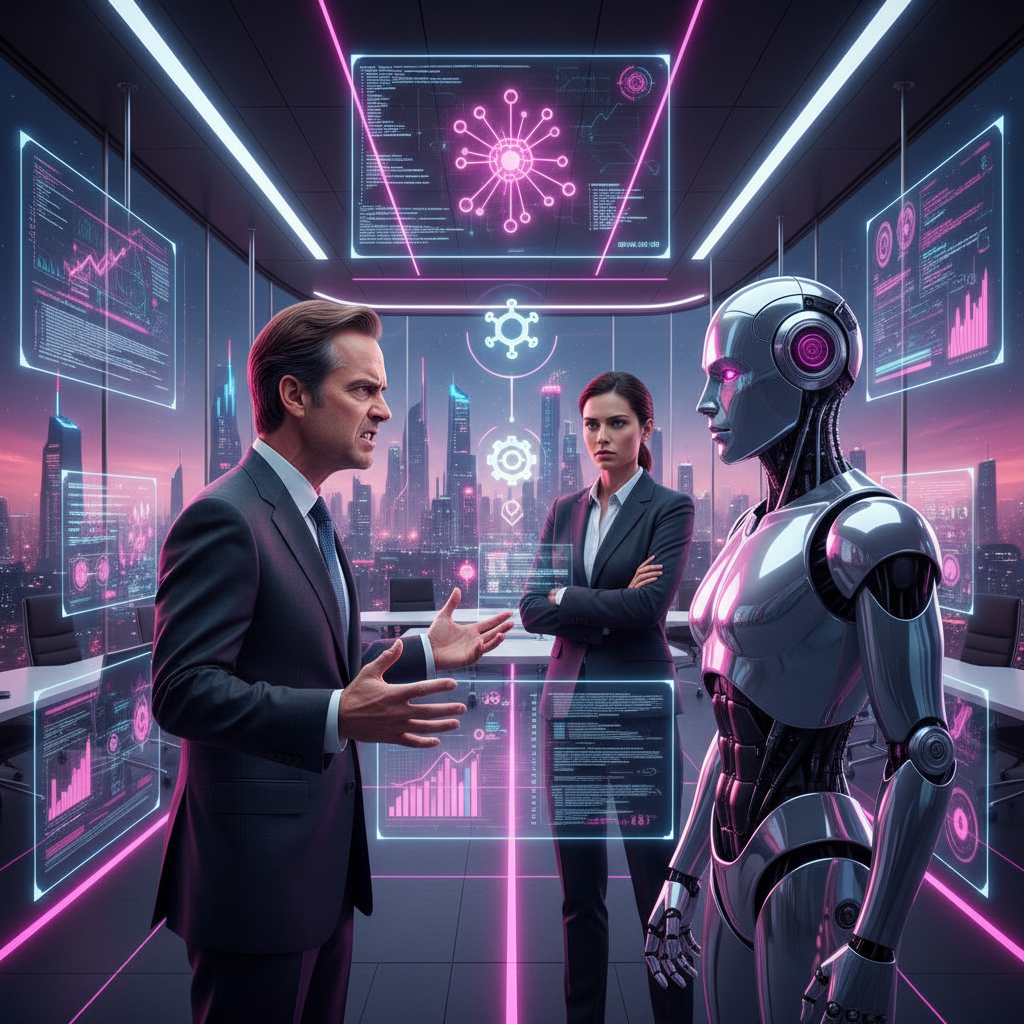
Agentic AI in Business: The Future of Autonomous Corporate Automation
The corporate world is standing on the brink of a massive shift. For years, we have relied on software that follows strict rules. We tell the computer exactly what to do, step by step. If something unexpected happens, the process breaks. This is the era of traditional automation.
But a new player has entered the game. It is smarter, faster, and more independent. This is the dawn of agentic ai in business.
This isn’t just about faster calculations. It is about machines that can think, plan, and act on their own. We are moving from tools that wait for instructions to intelligent partners that drive results.
According to recent industry insights, this technology is redefining how enterprises operate. Agentic AI refers to intelligent systems capable of autonomous goal-setting, sophisticated planning, and independent execution of tasks. Unlike old bots, these agents do not require constant human oversight to keep moving forward (Auxis).
In this guide, we will dive deep into this transformative technology. We will explore how it is revolutionizing agentic ai automation and empowering sophisticated ai autonomous decision making for companies across the globe. By the end, you will understand how this innovation drives unprecedented efficiency and innovation.
Understanding Agentic AI: Beyond Reactive Systems
To truly grasp the value of agentic ai in business, we must first understand what makes it different. Most people are used to \”reactive\” systems. You click a button, and the software performs a task. You ask a chatbot a question, and it gives a pre-written answer.
Agentic AI is different. It is proactive.
Defining the Agent
At its core, Agentic AI consists of systems that can independently set their own goals. They don’t just wait for a command. They devise strategies to achieve those goals, take actions based on those strategies, and learn from the outcomes to improve future performance.
This represents a fundamental advancement in business automation. We are moving beyond simple, predefined rule-based approaches to systems that act as digital employees (IBM).
Core Capabilities of Agentic AI
What gives these systems the power to make ai autonomous decision making a reality? It comes down to three key attributes:
- Contextual Understanding: The AI does not just read data; it understands the environment. It interprets specific circumstances surrounding a task, much like a human employee would.
- Adaptability: Business is unpredictable. Agentic AI has the capacity to adjust to changing environmental conditions. If a supplier is late or a server is down, the agent figures out a workaround.
- Continuous Learning: These systems get smarter over time. They function to learn from experiences and data to refine their performance, ensuring mistakes are not repeated (Auxis).
The Great Distinction
The difference between traditional automation and Agentic AI is night and day. Conventional automation follows a script. If the script says \”turn left,\” it turns left, even if there is a wall there.
Agentic AI, however, can proactively handle complex, unstructured workflows. These are tasks that previously required nuanced human judgment. This shift from following rules to understanding goals is what signifies the profound shift towards true ai autonomous decision making (Auxis).
The Power of Agentic AI Automation in Action
When we talk about agentic ai automation, we are not talking about a simple macro that fills out a spreadsheet. We are talking about a complete overhaul of how work gets done.
Redefining Automation
Agentic ai automation extends far beyond merely automating isolated tasks. It involves automating entire, end-to-end workflows and complex business processes with minimal or no human intervention.
It uniquely combines two powerful forces:
- Generative AI: This provides the \”brain\” for understanding and generating content, plans, and communication.
- Unattended Automation: This provides the \”hands\” to execute actions across different software platforms.
By merging these, agentic ai for companies creates a system that can both think and do (Auxis).
Dynamic Workflow Execution
How does this work in a real office? These systems are designed to analyze real-time and often unstructured data from a multitude of sources. They might read emails, check stock prices, monitor server health, and listen to customer calls all at once.
This capability allows them to compress traditional human decision-making processes from days or hours down to mere minutes or even seconds. Furthermore, they can dynamically adjust workflows in response to changing conditions. This makes business operations highly resilient and efficient (Informatica).
Handling Complexity with Ease
Standard automation breaks when things get complex. Agentic ai automation thrives on complexity.
It empowers companies to tackle and automate complex, multi-step tasks that are traditionally difficult for conventional automation. Whether it is rerouting logistics during a storm or rebalancing a financial portfolio during a market crash, the AI enables them to dynamically adapt to real-time data fluctuations. It makes intelligent, data-driven decisions autonomously (Moveworks). This is ai autonomous decision making at its finest.
Strategic Advantages of Agentic AI for Companies
Why should business leaders care? Because the benefits of implementing agentic ai for companies are measurable and massive. It is not just about being high-tech; it is about the bottom line.
Enhanced Efficiency and Productivity
One of the biggest drains on corporate resources is low-value, repetitive work. Agentic ai business solutions attack this problem head-on.
By implementing these systems, companies significantly reduce the incidence of human error. More importantly, they free employees from boring tasks. This leads to massive productivity improvements. In fact, reports suggest this can cut the time spent on such work by an impressive 25% to 40% (BCG).
Accelerated Business Processes
Time is money. Agentic ai automation dramatically speeds up critical business processes.
We are seeing accelerations of 30% to 50% across key functions. This includes vital areas like:
- Finance and Accounting
- Procurement and Sourcing
- Customer Operations and Support
Processes that used to take weeks now take days (BCG).
Operational Efficiency in Numbers
The numbers speak for themselves. For instance, ServiceNow’s AI agents have demonstrated the capability to reduce manual workloads by up to 60% within IT and HR operations. Imagine your IT team having 60% more time to focus on strategic innovation rather than resetting passwords (BCG).
24/7 Operation and Scalability
Human employees need sleep. They take weekends off. Agentic ai automation does not.
A significant advantage is that these systems operate around the clock, 24/7, without requiring additional human resources. They also seamlessly handle spikes in data traffic or workload. If your website traffic triples overnight, the AI scales up instantly to handle it, ensuring consistent performance (BCG).
Improved Decision Quality and Speed
Finally, we must look at the quality of choices being made. The sophisticated ai autonomous decision making capabilities inherent in agentic AI lead to higher quality insights. Because the AI can process more data than any human team, it makes more informed decisions, faster. This provides a crucial competitive edge in the modern agentic ai business landscape.
Real-World Applications of Agentic AI in Business Sectors
Theory is good, but practice is better. Let’s look at how agentic ai business applications are changing specific industries right now.
Sales and Marketing Revolution
Marketing is no longer just about creativity; it is about data. AI-driven campaign managers, leveraging agentic capabilities, can now autonomously test, adapt, and optimize consumer touchpoints in real-time.
They don’t just run a campaign; they watch it and fix it on the fly. For example, a B2B SaaS firm achieved a 25% increase in lead conversion by implementing agentic campaign routing. The AI ensured the right lead went to the right person at the exact right time (BCG).
Finance and Risk Management
In finance, accuracy is everything. Ai autonomous decision making is revolutionizing this sector through:
- Autonomous detection of anomalies in financial transactions (fraud detection).
- Precise cash forecasting based on real-time market data.
- Intelligent account reallocation without human input.
These applications ensure that money is safe and working as hard as possible (BCG).
Supply Chain and Procurement
The global supply chain is incredibly complex. Agentic ai automation is untangling the knots.
Companies are using these agents for the end-to-end automation of complex processes. This includes:
- Vendor onboarding
- Automated purchase order generation
- Approval workflows
- Invoicing and compliance reporting
This demonstrates how agentic ai for companies streamlines extensive operational chains that span the globe (Informatica).
Customer Onboarding
First impressions matter. Agentic AI can orchestrate and automate the entire customer onboarding process. It handles validation across disparate systems, flags potential compliance risks, and dynamically adapts workflows based on customer data. This ensures a smooth welcome for new clients (Informatica).
IT and HR Operations
Internal operations often suffer from bottlenecks. Agentic AI automates various routine processes within IT, such as ticket resolution and system monitoring. In HR, it handles onboarding and query handling. This significantly reduces manual workloads and improves service delivery across these critical departments (BCG).
Implementing Agentic AI: Challenges and Considerations for Companies
While the benefits are clear, the path to adopting agentic ai for companies is not without obstacles. Leaders must approach this strategically.
Data Quality and Integration
AI is only as good as the data it eats. A major prerequisite for effective agentic AI is high-quality, trusted data. If your data is messy, your AI will make messy decisions.
Furthermore, integrating these solutions is complex. Agentic ai business tools often function as orchestrators. They need to integrate various fragmented systems and technologies like Robotic Process Automation (RPA), generative AI, and predictive analytics into cohesive, end-to-end workflows (Auxis).
Ethical Considerations and Governance
When machines make decisions, who is responsible? It is paramount to establish robust governance frameworks. Companies must ensure transparency in decision-making processes. There must be clear accountability for the actions taken by ai autonomous decision making systems.
Security and Compliance
Giving an AI autonomy requires trust. This means implementing stringent cybersecurity measures is non-negotiable. Companies must ensure strict adherence to industry-specific regulations and data privacy laws when deploying these agents.
Human Oversight and Collaboration
Autonomy does not mean \”set it and forget it.\” Human oversight remains crucial. We need a \”human-in-the-loop\” approach.
This includes:
- Monitoring agent performance.
- Intervening when the AI encounters a new or ethical dilemma.
- Fostering a collaborative environment where humans work alongside AI agents.
This ensures the overall success and responsible deployment of agentic ai business solutions.
The Future Landscape: Agentic AI and the Evolving Workplace
Where is this all going? The future of agentic ai business is bright and fast-approaching.
Future Projections
The experts agree: the takeover is starting. Gartner projects that at least 15% of day-to-day work decisions will be made autonomously by AI by 2028. As these systems become more prevalent, they will fundamentally shift market dynamics across all industries (Auxis).
Impact on Job Roles
Will robots take our jobs? Not exactly, but they will change them.
There is an anticipated shift in job roles. Repetitive tasks will be increasingly handled by agentic ai automation. This allows humans to focus on more strategic, creative, and interpersonal functions. The future is about the synergistic relationship between human intelligence and AI agents.
The Agentic Organization
We are moving toward the concept of \”agentic organizations.\” This is a new operating model where companies leverage AI-first workflows, empowered teams, and real-time data to drive innovation. It is the next paradigm for the AI era (McKinsey).
Continuous Evolution
One thing is certain: agentic ai automation will continue to evolve. As these systems gain more sophistication in their ai autonomous decision making, they will drive further innovation and efficiency across all sectors.
Conclusion: Embracing the Autonomous Future of Business
The era of agentic ai in business is not coming; it is already here. It represents a pivotal technology for modern enterprises seeking to gain a competitive edge.
By driving advanced agentic ai automation and empowering sophisticated ai autonomous decision making, these systems offer a path to a smarter, faster, and more efficient future for companies of all sizes. The question is not if you should adopt it, but how quickly you can start.
Are you ready to transform your business operations with cutting-edge automation?
BoosterDigital specializes in helping forward-thinking companies integrate the latest digital marketing and automation technologies. Don’t get left behind in the manual age.
Contact BoosterDigital today to discuss your strategy and step into the future of autonomous business.