
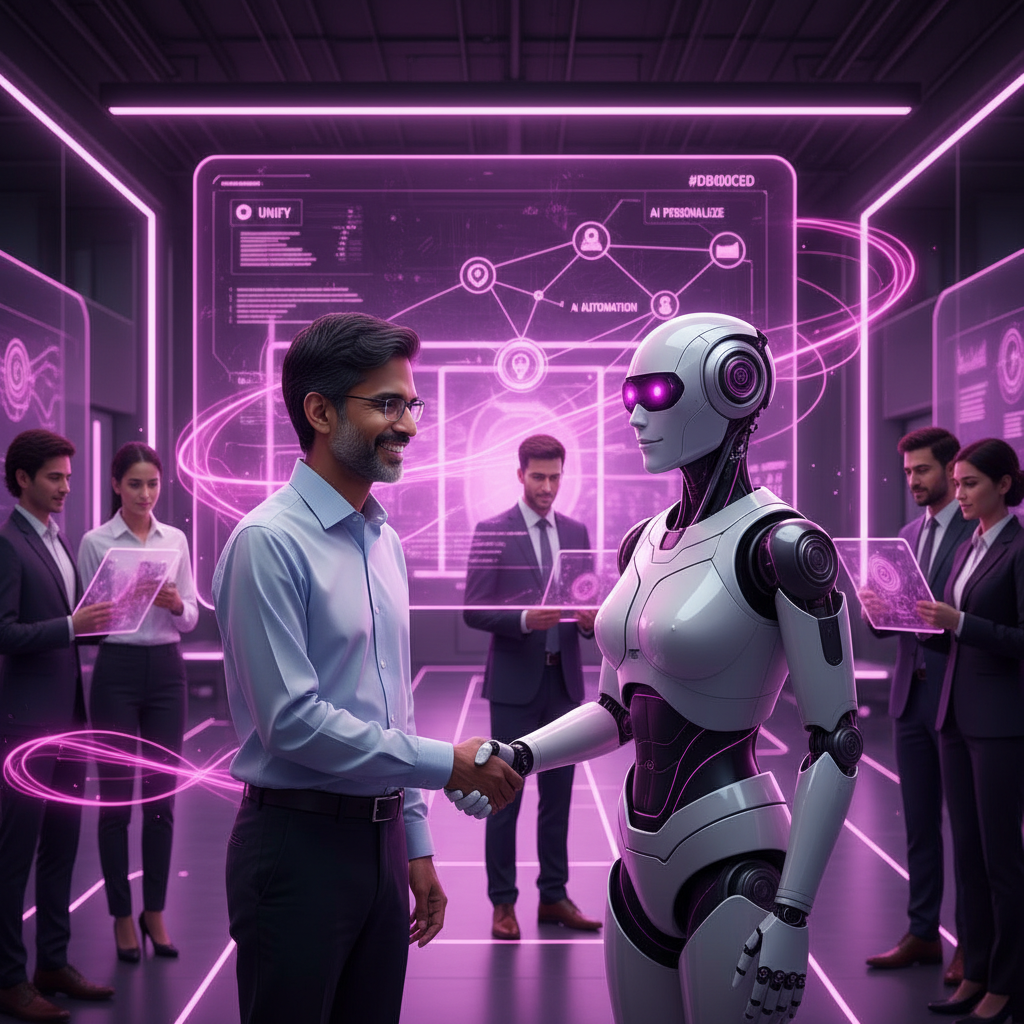
AI Omnichannel Marketing: Revolutionizing Consistent Customer Experiences Across Every Touchpoint
In today’s hyper-connected world, your customers are everywhere. They browse on mobile apps during their commute, compare prices on desktops at work, and check social media before bed. They expect fluid, consistent, and personalized experiences across every single brand interaction. Unfortunately, the traditional multi-channel approach often falls short, leading to fragmented journeys that frustrate users and lose sales.
Enter ai omnichannel marketing. This is not just a buzzword; it is a fundamental shift in how businesses connect with their audience. By integrating artificial intelligence into your marketing stack, you can finally solve the puzzle of disjointed data.
AI omnichannel marketing empowers you to deliver unified, personalized customer experiences across multiple channels—like email, social media, apps, and in-store interactions—by analyzing data, predicting behaviors, and automating tasks at scale. According to industry leaders like Bloomreach and Martech360, this technological leap is what separates market leaders from those struggling to catch up.
In this comprehensive guide, we will explore how AI empowers businesses to achieve truly automated, integrated, and consistent experiences across all touchpoints. We will detail the mechanisms, benefits, and implementation strategies you need to know.
Understanding AI Omnichannel Marketing: Beyond Just Multi-Channel
To master this strategy, we must first define what we mean by ai omnichannel marketing. Many businesses mistake \”multi-channel\” for \”omnichannel,\” but there is a distinct difference.
Multi-channel marketing means you have a presence on Facebook, email, and your website. However, these channels often operate in silos. They don’t talk to each other. Omnichannel marketing, heavily enhanced by AI, is about providing a fully integrated and consistent experience. It ensures that a customer can seamlessly transition between channels without disruption.
AI serves as the critical tool in personalizing and enhancing this entire customer journey. It acts as the \”brain\” behind the operation, ensuring that the left hand always knows what the right hand is doing. (Source: Bloomreach, Martech360).
The \”AI\” Component Explained
How does the artificial intelligence component actually work within this framework? It’s all about data processing power.
- Real-time Analysis: AI analyzes customer data, such as browsing history, click maps, and past purchases.
- Hyper-Personalization: It uses this data to tailor content, product recommendations, and offers in real-time across channels.
- Contextual Awareness: AI understands when and where a customer is interacting with your brand.
For example, if a user buys a winter coat, AI ensures they stop seeing ads for that same coat and instead start seeing ads for matching gloves. This level of hyper-personalization is impossible to manage manually at scale. (Source: Gracker.ai, Martech360).
The Strategic Shift to AI for Integrated Marketing
Adopting this technology requires a strategic shift towards ai for integrated marketing. This involves taking a holistic view where all marketing efforts are interconnected and informed by AI-driven insights.
It ensures a unified workflow. When a customer takes an action on one channel—like viewing a product on your mobile app—that action is immediately recognized by the central AI system. This instantly informs interactions on another channel, such as sending a follow-up email or adjusting the website homepage banner.
This ecosystem approach eliminates the \”amnesia\” that brands often suffer from, where they treat loyal customers like strangers simply because they switched devices. (Source: Salesmanago).
The Power of Omnichannel Automation with AI: Streamlining Operations and Enhancing Personalization
Efficiency is the engine of modern business growth. Omnichannel automation with AI refers to the strategic use of technology to deliver a unified and personalized customer experience across all touchpoints while automating routine tasks.
By leveraging machine learning and automation scripts, businesses can ensure that no customer is left unattended, regardless of the time of day or the channel they choose to use. (Source: Gracker.ai, StackAdapt).
Reducing Manual Workload
Marketing teams are often bogged down by repetitive execution tasks. AI steps in to alleviate this burden significantly.
- Automated Campaigns: AI handles the scheduling and deployment of complex email sequences based on user triggers.
- Social Media Management: Intelligent tools can auto-post content at optimal times for engagement.
- Customer Service: AI-driven chatbots provide 24/7 real-time support, answering common queries instantly and routing complex issues to human agents.
This automation frees marketers to focus on high-level strategy and creative development rather than getting stuck in the weeds of daily administration. (Source: MoEngage, Waveon, AMA).
Achieving Scalability
One of the biggest challenges in marketing is scaling personalization. It is easy to personalize a message for ten people; it is nearly impossible to do it manually for a million.
Omnichannel automation with AI allows businesses to expand their reach and maintain personalization across a growing customer base without a proportionate increase in manual effort. The AI creates a \”segment of one\” for every single user, scaling the personal touch indefinitely.
Alignment with Integrated Marketing
This level of automation connects directly back to ai for integrated marketing. It ensures that all automated communications are aligned with your overall strategy. Whether a customer receives a push notification or a newsletter, the brand voice, tone, and offer remain consistent, building trust and recognition.
Achieving Consistency with Cross-Platform AI Marketing Automation
Your customers do not see \”channels\”; they see one brand. Cross-platform ai marketing automation involves using AI to manage and execute marketing campaigns across various digital and physical channels, ensuring a cohesive and continuous customer experience regardless of the platform.
Seamless Channel Unification
The goal is to make the technology invisible to the user. AI ensures consistent messaging and smooth transitions between online and offline touchpoints using real-time data analysis.
Consider this scenario: A customer browses a specific pair of running shoes on your mobile app but doesn’t buy them. Later, they open Facebook. Through cross-platform ai marketing automation, the system recognizes the user and triggers a personalized ad showing those exact shoes, perhaps with a limited-time free shipping offer.
This continuity keeps your brand top-of-mind without being intrusive. It feels helpful rather than spammy because it is relevant to their recent interests. (Source: Bloomreach).
Dynamic Content Delivery
Static content is a thing of the past. AI enables the delivery of dynamic content that adapts to the user’s interaction on different platforms.
Generative AI tools are now capable of automating content creation at a granular level:
- Ad Copy: Generating variations of text to see what resonates best.
- Subject Lines: crafting email headers that are most likely to be opened by that specific user.
- Visuals: Adjusting imagery to match user preferences.
This ensures that the content is always tailored for specific channels and targeted campaigns, maximizing engagement rates. (Source: Bloomreach).
Supporting the Customer Journey
This relates directly to ai customer journey automation. By maintaining consistency across platforms, AI helps to create a predictable and satisfying customer journey. It minimizes friction points as customers move between different brand touchpoints, removing the frustration of having to \”restart\” their relationship with your brand every time they switch devices.
Optimizing the Path: AI Customer Journey Automation for Personalized Engagement
The customer journey is rarely a straight line. It is a winding path of research, consideration, and decision-making. AI customer journey automation is the application of AI to map, predict, and personalize these individual paths.
It guides customers through relevant touchpoints based on their behavior, preferences, and deep predictive analytics.
The Role of Predictive Analytics
Machine learning doesn’t just look at what happened in the past; it forecasts what will happen in the future.
Predictive analytics can identify behaviors such as:
- Churn Risk: Which customers are likely to stop buying?
- Conversion Probability: Which leads are ready to buy now?
- Preferred Channels: Does this user prefer SMS or Email?
Pre-built prediction models can forecast actions like dormancy or app uninstalls, enabling you to trigger RFM-based (recency, frequency, monetary) campaigns to re-engage users before they are lost. (Source: Gracker.ai, MoEngage).
Examples of AI Guiding Customers
Here is what ai customer journey automation looks like in practice:
- Cart Abandonment: If a customer leaves items in their cart, AI triggers an automated email with a friendly reminder and potentially a small discount code to nudge the purchase.
- Smart Recommendations: Based on browsing history, AI displays past purchases or recently viewed items on the homepage for quick reorders. (Source: Bloomreach).
- Churn Prevention: For customers identified as \”high churn risk,\” AI automatically sends retention emails with high-value content or offers to specific segments. (Source: Gracker.ai, MoEngage).
This automated journey is not confined to one channel. It spans across all available touchpoints, ensuring a continuous and relevant experience enabled by AI’s ability to orchestrate a unified workflow through omnichannel automation with ai.
Key Benefits of Embracing AI in Omnichannel Marketing
Why should your business invest in these technologies? The benefits of ai omnichannel marketing are measurable and transformative.
Enhanced Customer Experience & Loyalty
Customers stay where they feel understood. AI-powered hyper-personalization, enabled by ai customer journey automation, leads to interactions that feel relevant and timely. This fosters stronger customer relationships, increases trust, and builds long-term loyalty.
Increased Operational Efficiency & Cost Savings
Omnichannel automation with AI drastically reduces the manual workload on your team. By automating repetitive tasks like segmentation, posting, and basic support, you save significant time and money. Your human talent can focus on creative and strategic initiatives that drive growth.
Deeper Customer Insights & Personalization at Scale
Data is the new oil, but it needs to be refined. AI’s ability to analyze vast amounts of data from all channels provides deeper insights into customer behavior than ever before. This allows for unprecedented levels of personalization across all marketing efforts—a core benefit of ai for integrated marketing.
Improved ROI and Business Growth
Ultimately, it comes down to the bottom line. By optimizing campaigns, predicting customer needs, and delivering consistent experiences through cross-platform ai marketing automation, businesses see a substantial increase in conversion rates. Better targeting means less wasted ad spend and higher revenue per customer.
Implementing AI Omnichannel Marketing: Strategic Considerations
Ready to get started? Implementing ai omnichannel marketing is a journey, not a switch you flip. Here are the strategic steps you need to take.
1. Unify Customer Data
You cannot analyze what you cannot see. The first crucial step is to consolidate customer data from all channels—social, web, app, POS—into a single, accessible platform, often a Customer Data Platform (CDP). This unified data feeds into ai for integrated marketing strategies and empowers the AI to make accurate predictions. (Source: Bloomreach, Martech360).
2. Adopt Symbiotic Marketer-AI Workflows
AI is a tool, not a replacement for human creativity. Marketers should define the focus areas, goals, and constraints. They provide the inputs, allowing the AI to run experiments and refine strategies based on these inputs. This collaborative approach enhances the effectiveness of omnichannel automation with ai. (Source: Bloomreach).
3. Leverage Integrated Platforms
Don’t try to build the tech stack from scratch if you don’t have to. Utilize platforms that offer pre-built AI models, comprehensive dashboards, and omnichannel prediction capabilities. Look for tools that support web layers, email automation, and app push notifications in one place. (Source: Bloomreach, Emarsys).
4. Start Small, Scale Strategically
It is easy to get overwhelmed. Start by using AI to gain insights into customer behavior patterns. Once you trust the data, gradually scale to implement chatbots, then move to hyper-personalization, and finally predictive promotions. (Source: Martech360).
Conclusion: The Future of Customer Engagement is Intelligent and Integrated
The marketing landscape is changing rapidly. AI omnichannel marketing is no longer a luxury for the biggest brands; it is a necessity for any business that wants to survive and thrive.
We have explored how this technology revolutionizes customer experiences by delivering seamless, automated, and integrated journeys. From the efficiency of omnichannel automation with ai to the predictive power of ai customer journey automation, the tools are here to transform your business.
The benefits are clear: enhanced customer experience, increased operational efficiency, deeper insights, and significantly improved ROI. The future of marketing lies in intelligently orchestrating every customer interaction.
Are you ready to unify your marketing and harness the power of AI? Businesses that embrace ai customer journey automation and the broader scope of AI in omnichannel strategies will be best positioned to thrive in an increasingly competitive landscape.
Don’t let your customer data go to waste. Contact BoosterDigital today to discover how we can help you implement a world-class AI omnichannel strategy that drives real results.